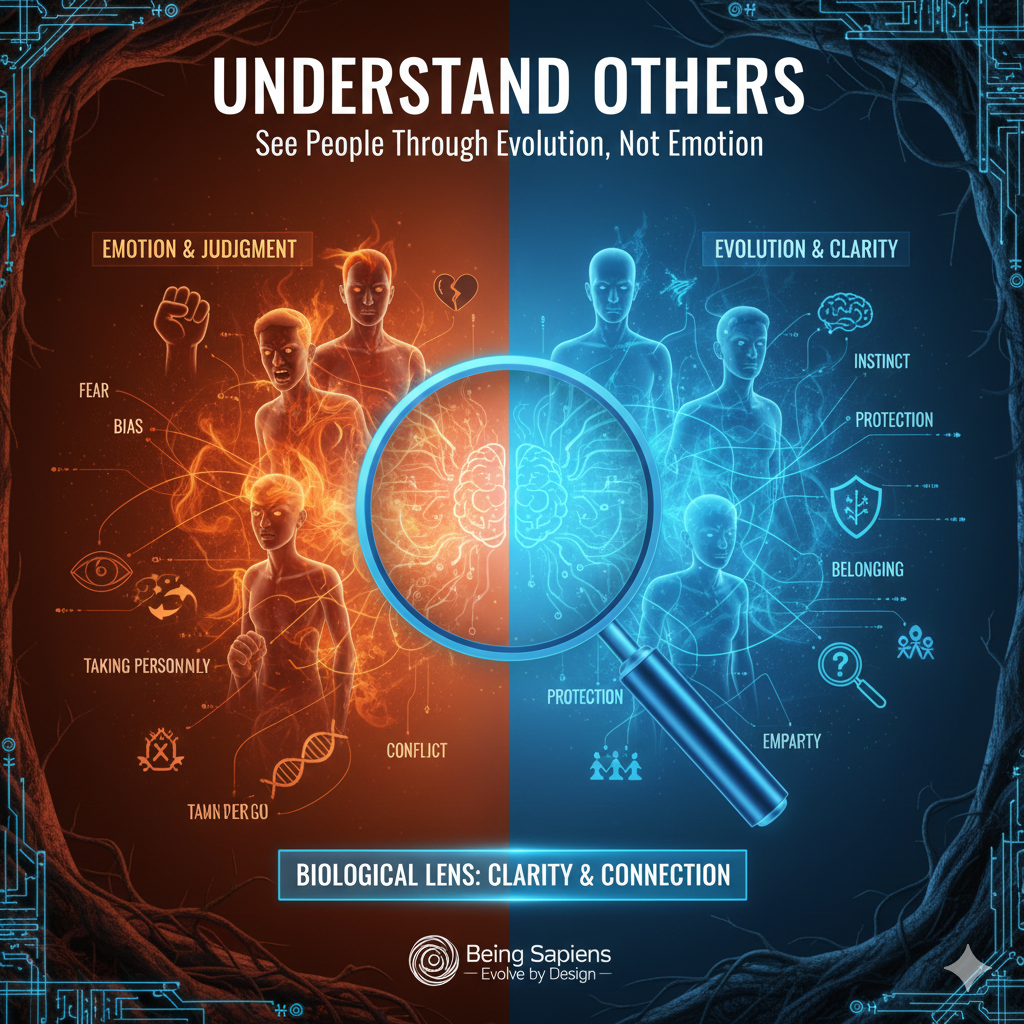
See People Through Evolution, Not Emotion
“Understanding others makes life easier than judging them.”
Humans misunderstand each other not because we are complicated,
but because we look at behavior through emotion, not evolution.
When someone lies, we get angry.
When someone is jealous, we take it personally.
When someone pulls away, we feel rejected.
When someone makes a mistake, we call them selfish, careless, or insensitive.
But once you understand evolution,
everything becomes clear:
People are not difficult.
They are simply evolved this way.
Your relationships — in family, friendships, love, workplace — instantly transform
when you stop reacting emotionally
and start observing biologically.
Why Understanding People Is Better Than Judging Them
Judging someone creates conflict.
Understanding someone creates clarity.
When you understand the evolutionary reasons behind human behavior:
-
you stop taking things personally
-
you stop assuming the worst
-
you see patterns instead of problems
-
you respond intelligently instead of emotionally
-
you become calmer, kinder, wiser
-
relationships become easier
Humans behave based on survival, reproduction, security, and emotional safety —
not because they are “good” or “bad.”
Let’s break it down.
Why People Lie (The Evolutionary View)
People lie because lying is a survival strategy, not a moral failure.
In nature, lying helped humans:
-
avoid danger
-
protect status
-
avoid punishment
-
maintain group approval
-
reduce conflict
-
secure resources
Even children lying about homework isn’t “wrong” —
it’s instinctive self-protection.
Understanding this shifts your reaction from:
-
“Why are you lying?” →
to -
“What are you trying to protect?”
And suddenly, the conversation becomes human instead of hostile.
Why We Get Jealous or Possessive
Jealousy is not immaturity.
It is evolution.
Jealousy evolved to:
-
protect bonds
-
prevent losing partners
-
secure reproduction stability
-
avoid being replaced
-
maintain emotional safety
Animals show jealousy.
Infants show jealousy.
Adults feel it too — naturally.
Understanding this helps you see jealousy as:
-
a signal, not a flaw
-
a need for reassurance, not control
-
an emotional insecurity, not disrespect
When you understand the biology behind it,
jealousy becomes easier to address — gently, compassionately, rationally.
Why Conflict Is Natural (Not a Sign of Failure)
Humans have different genetics, experiences, emotional needs, and survival styles.
Conflict is not brokenness.
Conflict is biology.
Two people surviving with two different strategies WILL collide.
-
One prioritizes safety
-
One prioritizes growth
-
One prioritizes control
-
One prioritizes freedom
-
One seeks validation
-
One avoids vulnerability
None of these are “wrong.”
They are evolutionary traits shaped by past environments.
Understanding this turns conflict from:
-
“You’re the problem”
to -
“This is two survival systems clashing.”
Suddenly, you discuss.
You don’t defend.
The Science Behind Attraction & Bonding
Attraction is not magic.
It is biology.
We feel drawn to people who:
-
seem safe
-
seem emotionally available
-
offer stability
-
offer status, protection, or care
-
match our evolutionary triggers
Bonding is built on:
-
oxytocin
-
dopamine
-
serotonin
-
attachment styles
-
childhood conditioning
-
hormonal cycles
When you understand this, you stop romanticizing emotions
and start understanding them clearly.
You stop chasing chemistry
and start evaluating compatibility.
You stop forcing relationships
and start aligning with biology.
Why We See Ourselves One Way and Others Another
Evolution has wired humans with self-serving bias:
-
When we make mistakes → we justify.
-
When others make mistakes → we judge.
Why?
Because our brain protects our identity more than anyone else’s.
Your brain says:
-
“I did it because I was tired.”
-
“He did it because he’s irresponsible.”
This bias destroys relationships.
Understanding others requires:
-
stepping outside your emotional perspective
-
seeing behavior through survival instincts, not assumptions
-
reminding yourself that the same rule applies to you
This shift makes you calmer and far less reactive.
Unity Is Not Optional — It Is Evolution
Humans survived because they worked together.
No human alone could:
-
hunt large animals
-
raise children safely
-
protect a tribe
-
build shelter
-
build society
-
create tools
-
grow crops
-
explore land
Cooperation is the strongest evolutionary advantage our species has.
Today, unity matters even more:
-
in families
-
in workplaces
-
in communities
-
in global crises
-
in friendships
-
in relationships
-
in raising children
-
in innovation
-
in social stability
Understanding others — instead of judging them — is not just emotional intelligence.
It is evolutionary intelligence.
It keeps the tribe stable.
It prevents unnecessary conflict.
It strengthens cooperation.
It makes survival easier for everyone.
When You Understand Others, You Evolve
Once you see people through the lens of evolution:
-
anger reduces
-
empathy increases
-
conversations become easier
-
conflicts resolve faster
-
relationships feel lighter
-
expectations become realistic
-
forgiveness becomes natural
-
judgment disappears
-
clarity replaces confusion
Life becomes simpler
when people stop being “mysterious”
and start being predictable biological creatures.
The more you understand others,
the easier it becomes to navigate life.
Sapiens Reflection
People are not difficult.
They are ancient organisms with ancient instincts reacting to a modern world.
Once you understand:
-
their instincts
-
their hormones
-
their survival patterns
-
their emotional needs
-
their insecurities
-
their evolutionary triggers
…everything makes sense.
Understanding is not weakness.
It is strength.
It is intelligence.
It is evolution.
Because the more we understand each other,
the less we fight each other —
and the more we grow together.
Understanding others makes life easier than judging them.
This is how you Evolve by Design.