We blame ourselves for “not being motivated,” but the truth is simple: your brain was never designed for motivation.
It was designed for survival.
For millions of years, humans lived in a world where food was scarce, danger was constant, and energy was precious. In that world, your brain’s number one job was to keep you alive, not to help you grow, build muscles, study, or achieve long-term goals.
Your brain still carries that ancient design today.
Your Brain Is Built for Survival, Not Success
Let’s make this very clear:
-
Your brain doesn’t care about your goals.
-
It cares about conserving energy.
-
It cares about avoiding risk.
-
It cares about staying safe.
In the wild, wasting energy meant death.
Running after something for too long? You collapse.
Exploring too far? You get eaten.
Taking unnecessary risks? You don’t survive long enough to pass on your genes.
So the brain evolved a simple rule:
“Use energy only when absolutely necessary.”
And because of that, humans evolved what scientists call “energy efficiency bias.”
Which means:
Your default mode is not action.
Your default mode is conservation.
This is why sitting, scrolling, postponing, and delaying feel natural.
And why effort feels unnatural.
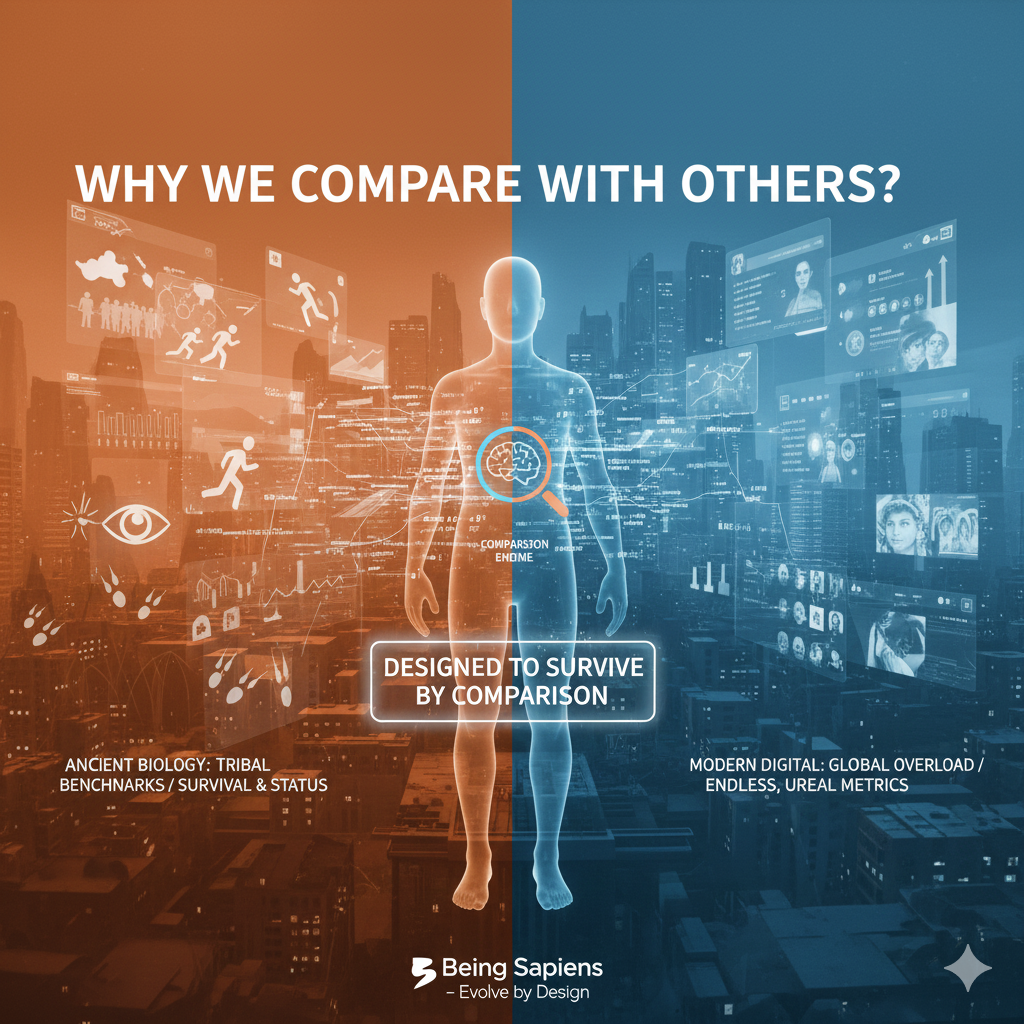
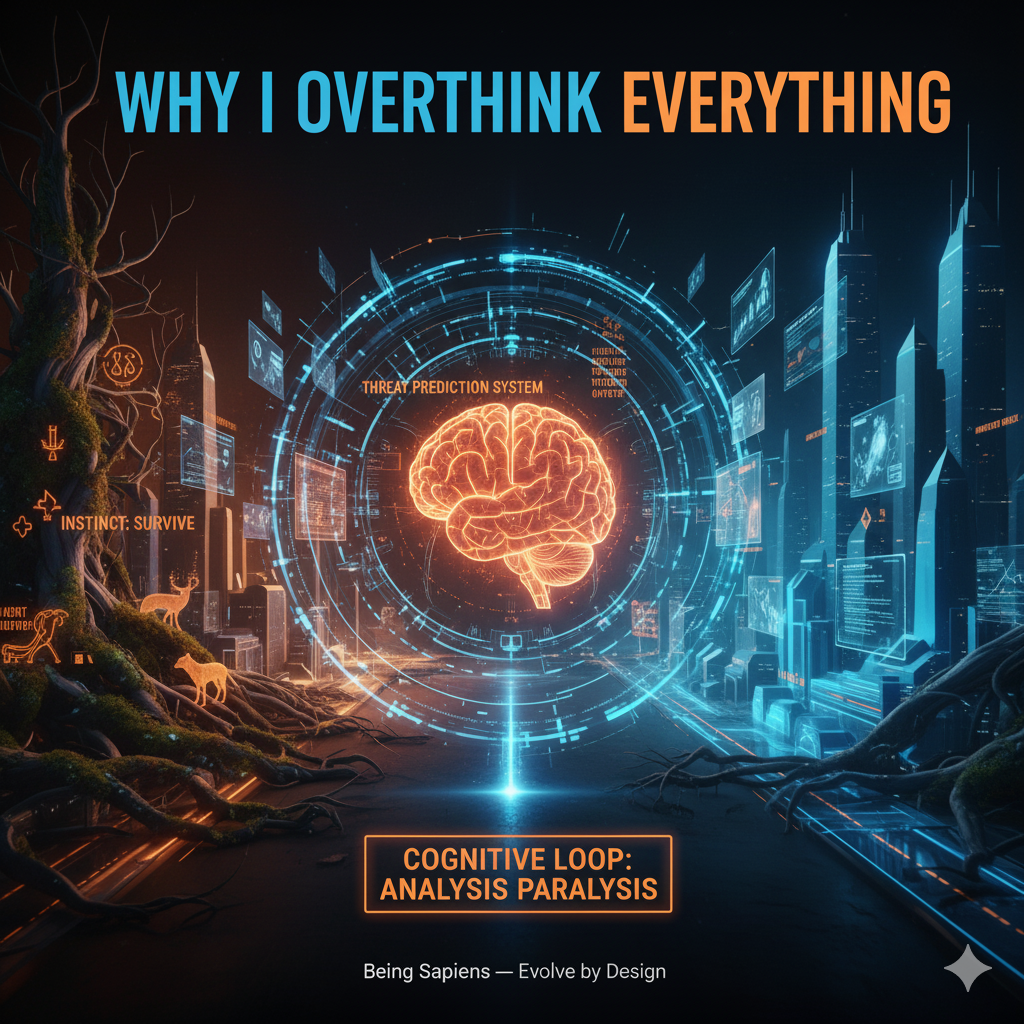
Your brain still thinks you are living in the jungle.
Why Motivation Starts High and Drops Fast
Most motivation doesn’t come from inside you — it comes from external triggers:
-
You see someone successful
-
You watch an inspiring video
-
You hear a story
-
You get emotional
-
You imagine a good future
This creates a temporary spike in dopamine, the brain chemical responsible for craving and desire.
But dopamine spikes don’t last long.
They are not designed to.
Once the emotional high fades, your brain switches back to its default mode:
“Conserve energy. Do what is safe. Avoid unnecessary effort.”
This is why Day 1 feels exciting, but Day 3 feels meaningless.
The Gym Example: Evolution in Action
Suppose you see a guy at the gym with a perfect physique.
You get inspired.
You think: “I want that body.”
So you join the gym, start working out…
and within a few days, you notice nothing has changed.
Here’s how your ancient brain processes this:
-
“This is taking too much energy.”
-
“No visible reward yet.”
-
“This is unsafe for my energy budget.”
-
“Stop doing it.”
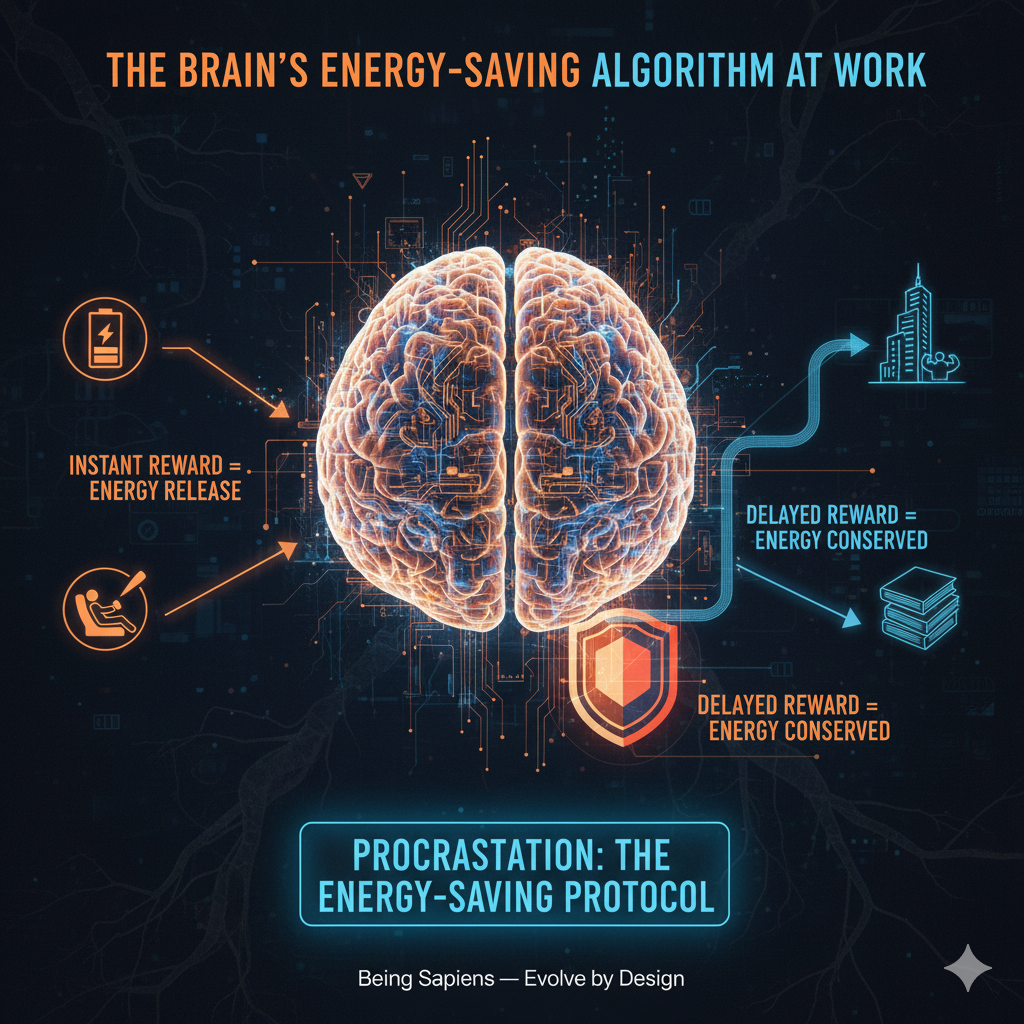
This is called Reward Prediction Error, a well-studied brain mechanism.
If effort is high but reward is not immediate,
your brain automatically reduces your drive.
Your brain is comparing effort vs benefit every single day.
If effort > benefit, motivation dies.
That’s not your fault — that’s biology.
The Same Happens in Studies, Work, and Money
Studying
Studying gives no instant reward.
In evolution, delayed reward = uncertainty = danger.
Your brain avoids it.
Work
New projects feel risky.
Your brain dislikes risk because risk once meant injury or death.
Saving & Investing
Saving money gives no immediate pleasure.
Spending does.
Investment requires patience — something your survival brain never evolved for.
The evolutionary rule is simple:
“A small reward now is better than a big reward later.”
Or in science: Present Bias.
This is why you’d rather have ₹500 now than ₹1500 after 3 months.
Your ancestors who chose immediate rewards survived.
Those who waited often didn’t.
The Real Reason You “Lose Motivation”
Not because you are weak.
Not because you lack discipline.
Not because you aren’t serious.
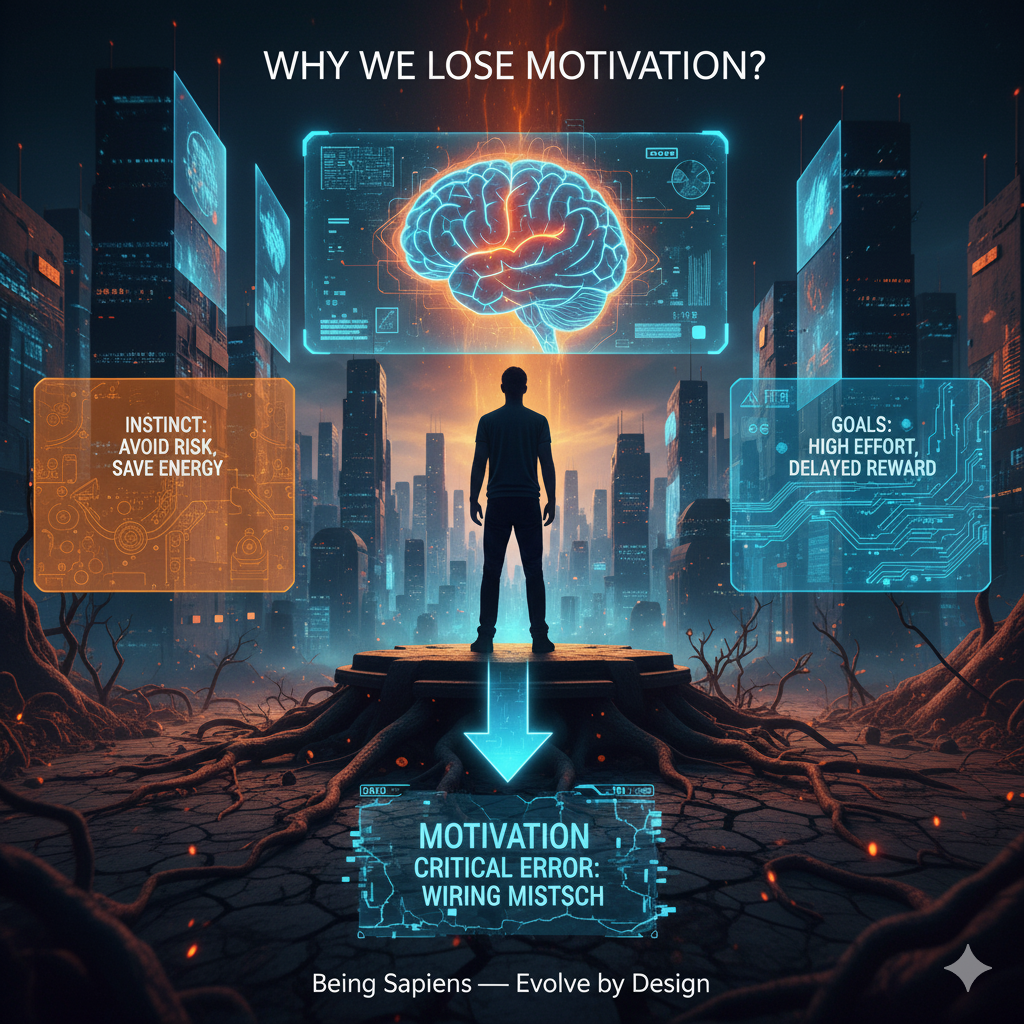
You lose motivation because:
-
Your brain wants immediate results
-
Long-term goals feel “unsafe” to an ancient mind
-
Effort without instant reward feels like danger
-
Motivation triggered by emotions fades quickly
-
Energy conservation is your default wiring
The modern world demands long-term focus.
But your brain still operates with prehistoric software.
You are using a Stone Age brain to build a digital-age life.
So What’s the Solution?
The solution is not motivation.
It is understanding your design.
Once you understand that your brain resists long-term effort by default, you stop expecting motivation to stay magically high.
You don’t need motivation.
You need systems, routines, and environments that:
-
Reduce effort
-
Create visible progress
-
Offer quick rewards
-
Lower friction
-
Reduce overthinking
-
Make the action the easiest option
That’s how you work with your biology, not against it.
Sapiens Reflection: The Truth About Motivation
Motivation is not a feeling you lose.
It’s a chemical you burn.
You are not failing because you lack motivation.
You are failing because you expect your ancient brain to support goals it was never designed for.
Once you understand that you were designed for survival,
you can evolve by design — consciously, intentionally, wisely.
That’s what Being Sapiens is all about.